Franschhoek Private Wine Tour: Guided Group vs Private Driver vs the Tram
Franschhoek sits about 75 km from central Cape Town, a 60 to 70 minute drive, and how you get there shapes the whole day. This guide separates the three realistic options: a guided group minivan tour, a private driver, and the self-guided hop-on-hop-off Wine Tram.
Short answer
A private Franschhoek wine tour means your own driver and vehicle for the day, typically covering three to five estates with tastings paid separately. The Wine Tram ticket costs R350 per adult, while tasting fees usually run R80 to R250 per person per estate. A private driver wins on flexibility; the tram wins on price.
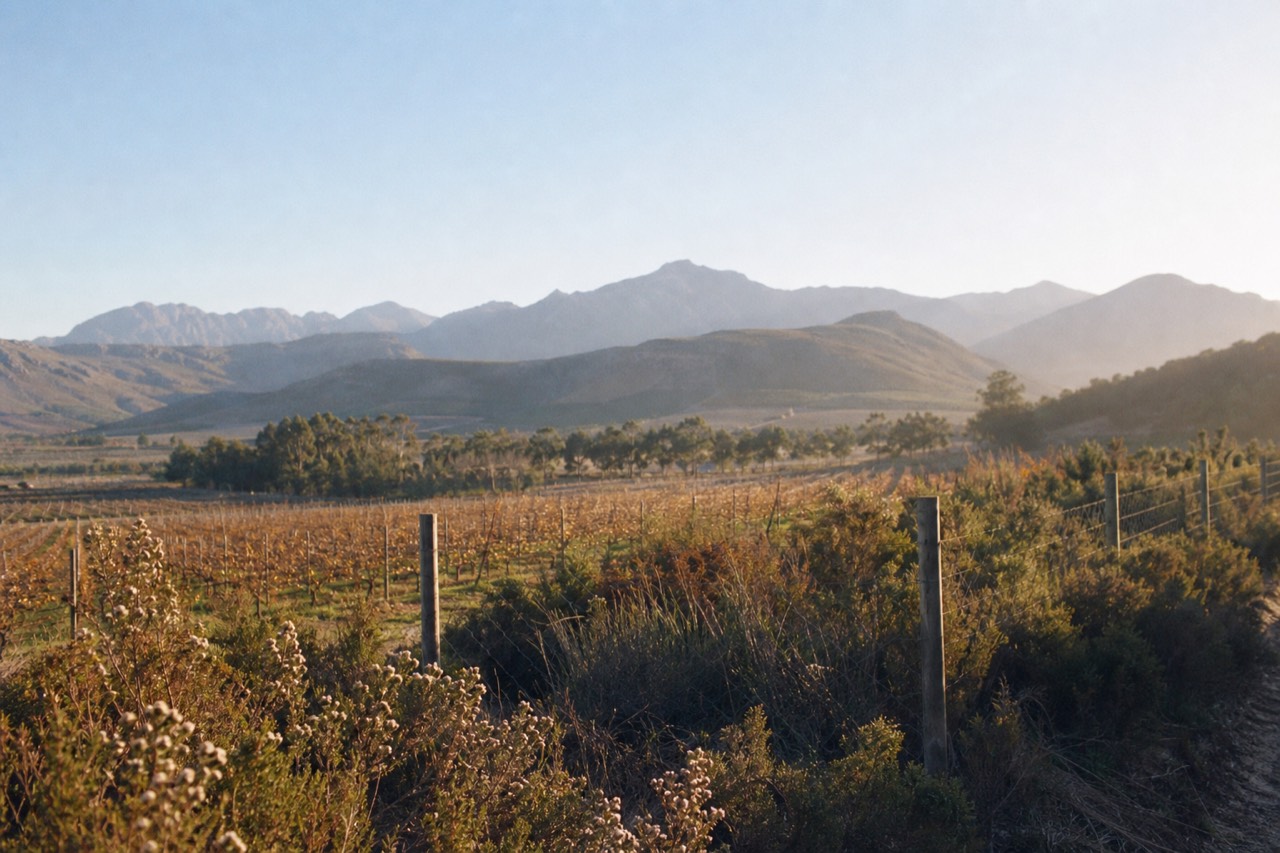
Franschhoek is the smallest of the three big winelands towns, roughly 75 km from central Cape Town, and the drive takes 60 to 70 minutes depending on traffic. That distance matters more than most first-time visitors expect. You are not hopping between bars in the city; you are spending a full day in a valley where the tasting rooms are scattered along farm roads, and every one of them pours alcohol.
That reality produces the single most common question travelers actually ask, in forums and in tasting rooms alike: should we take a guided group tour, hire a private driver, or ride the hop-on-hop-off Wine Tram and do it ourselves? All three work. They differ sharply on price, flexibility, group size and how much wine you can responsibly taste. This guide lays out what each format delivers, what a guided Franschhoek route typically includes, and why South Africa's drink-driving law quietly settles part of the debate.
What does a private Franschhoek wine tour actually include?
A private Franschhoek wine tour means a dedicated vehicle and driver for your group only, usually for a full day from Cape Town, covering roughly three to five estates with tasting fees, food and any activities paid separately at each stop. The driver sets the route with you, waits while you taste, and handles the 60 to 70 minute transfer each way, so nobody in your group has to stay sober and drive.
The defining feature is exclusivity, not luxury. A private tour can be a sedan with a driver-guide or a full luxury vehicle with a sommelier-level host; the format is the same. You choose the estates, or you accept the operator's suggested route, and you can change the plan mid-day in a way a group tour never allows. If a tasting room is crowded, you leave. If a lunch runs long, the driver waits.
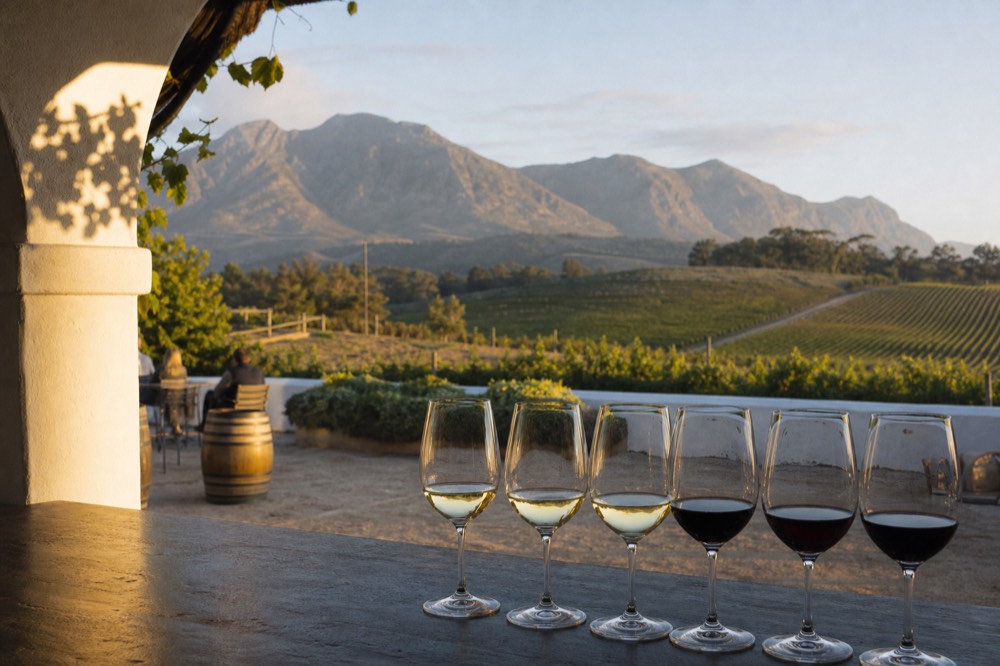
What is almost never included is the wine itself. Tasting fees at Franschhoek estates typically run R80 to R250 per person for a standard flight, with premium and paired tastings higher, and those are paid at the cellar door. Some estates waive or refund the fee with a bottle purchase. Lunch in the village is likewise your own account, and Franschhoek is a town where lunch deserves a budget line of its own.
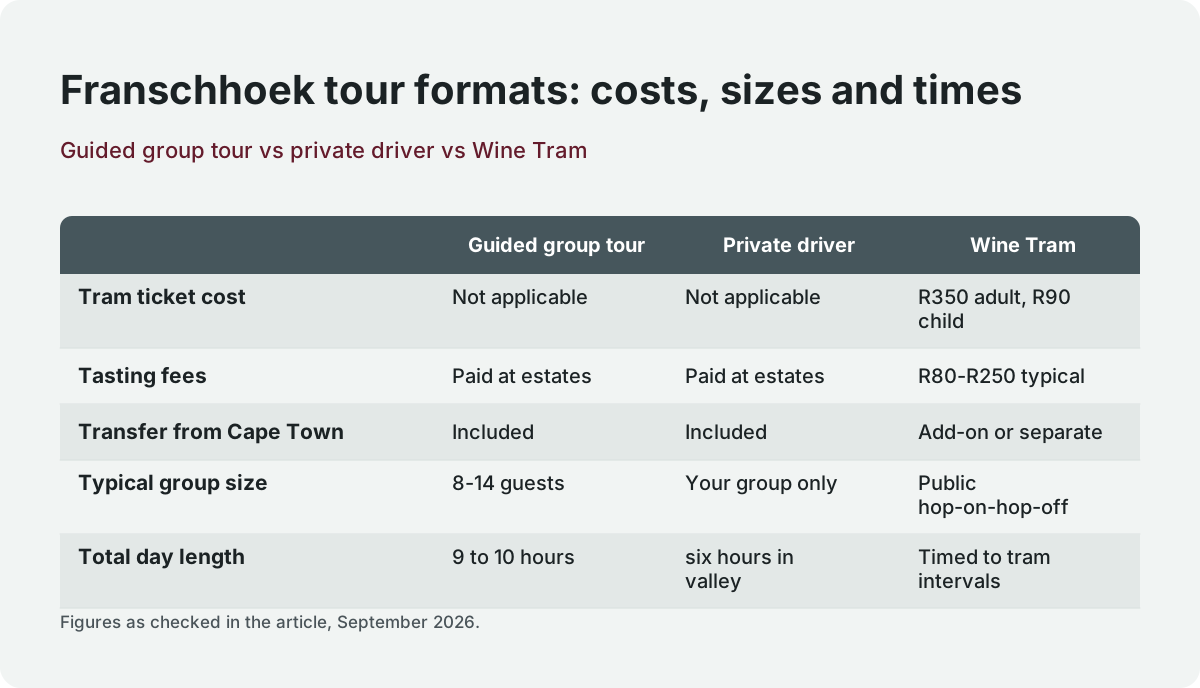
The third thing to understand is time. With a 60 to 70 minute transfer each way, a full-day private tour gives you roughly six hours in the valley. That is comfortable for three estates plus lunch, tight for five. Operators who promise more stops in a day are usually counting quick 20-minute tastings, not relaxed visits, so read the itinerary's pace as carefully as its length.
Guided group tour, private driver or Wine Tram: which is right for you?
Take a guided group minivan tour if you want a fixed price, a set route and company, typically sharing a vehicle with 8 to 14 other guests. Hire a private driver if flexibility and group size matter more than cost. Ride the Wine Tram if you are confident planning your own day: the hop-on-hop-off ticket is R350 per adult, R90 for children 3 to 17, under 3 free, with tastings extra.
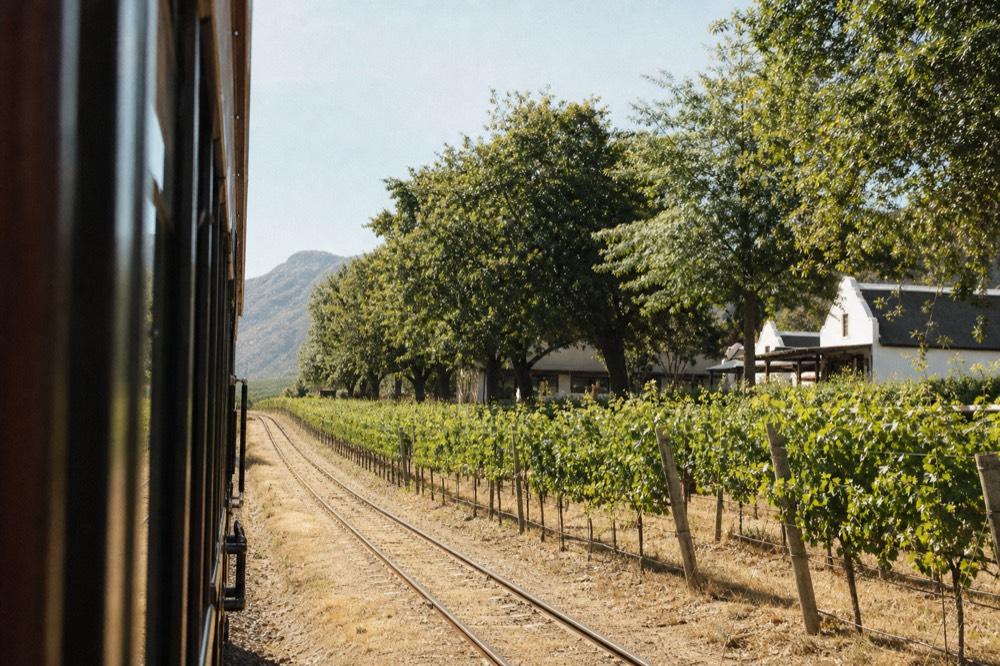
The tram deserves its popularity. It runs five color-coded lines through the valley using vintage-style trams and open-air tram-buses, covering roughly 30 estates collectively, with 7 to 9 estates per line, and it runs daily except major holidays like 24 to 25 December and 31 December to 1 January. It is genuinely self-guided: you pick a line, hop on and off at the estates it serves, and pay for tastings when you arrive. Details and line maps are on the operator's official site, winetram.co.za.
But the tram has structural limits. It only serves estates on its own lines, so anything off-network is unreachable. You wait for the next tram when you are ready to move, which can eat an hour at a slow stop. And it starts in Franschhoek village, so you still need a transfer from Cape Town, which is why many travelers book a combined coach-plus-tram package rather than driving themselves to the valley. Our Franschhoek Wine Tram guide breaks down each line and the trade-offs between them.
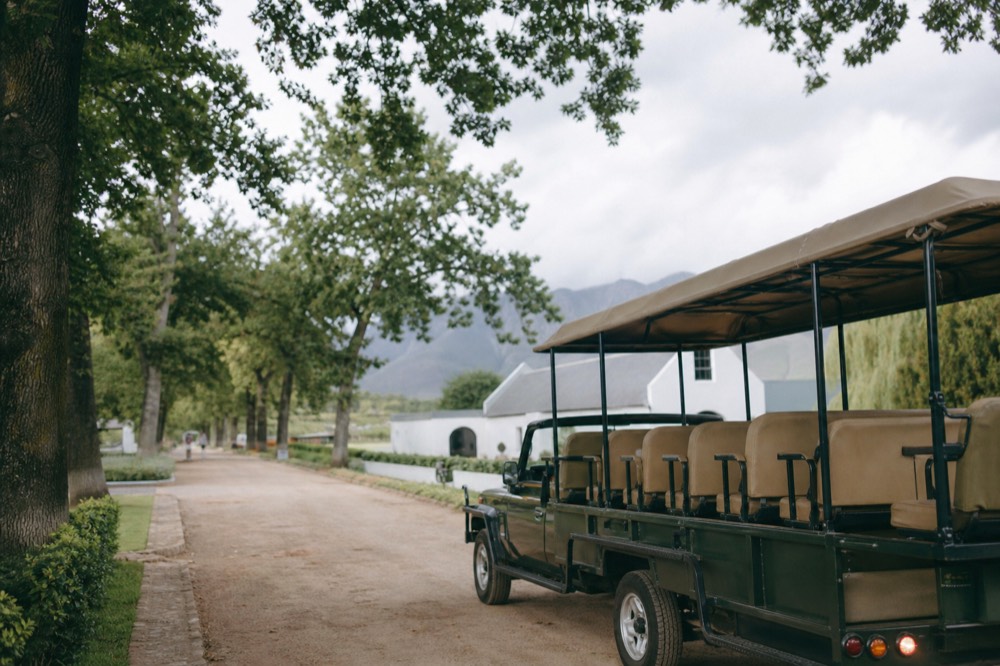
A guided group tour solves the transfer and the planning in one purchase. You are collected in Cape Town, driven to a curated set of estates, usually with a guide narrating the history, and returned in the evening. The cost sits between the tram and a private driver, and the trade is control: the route, the timing and the pace belong to the operator and the group, not to you.
A private driver is the top of the flexibility ladder and the top of the price ladder. You get the vehicle to yourselves, a route built around your estate wishlist, and the freedom to linger. For couples, small friend groups and families with mixed interests, the per-person gap versus a group tour often shrinks to a rounding error once you count what a private day lets you do.
Here is the honest comparison in one table:
| Factor | Guided group tour | Private driver | Wine Tram (self-guided) |
|---|---|---|---|
| Typical group size | Shared, roughly 8-14 guests | Your group only | Public hop-on-hop-off |
| Route control | Operator's fixed itinerary | Fully flexible, yours | Limited to estates on your line |
| Transfer from Cape Town | Included | Included | Add-on or separate booking |
| Tram ticket cost | Not applicable | Not applicable | R350 adult, R90 child 3-17 |
| Tasting fees | Usually paid at estates | Usually paid at estates | Paid at estates, R80-R250 typical |
| Pace | Fixed schedule | Change mid-day | Timed to tram intervals |
| Best for | Solo travelers, first-timers, budget | Couples, families, wine-focused groups | Confident independent planners |
What does a guided Franschhoek route typically include?
A standard guided route into Franschhoek includes hotel pickup in Cape Town, the scenic drive via the N1 and Helshoogte-style inland roads, two to three estate tastings, a lunch stop in or near the village, often a short village walk, and the return transfer, totaling roughly 9 to 10 hours door to door. Tasting fees are sometimes bundled, sometimes paid on site.
The drive itself is part of the product. Franschhoek sits about 30 minutes further inland from Stellenbosch via scenic passes like Helshoogte, and good guides use that stretch deliberately, stopping at viewpoints or routing past estates the tram does not touch. On a private day this is where the format earns its keep: the driver can add a Stellenbosch or Paarl estate on the way out, which is how many travelers end up comparing Stellenbosch or Franschhoek in the first place.
Estate selection on guided routes leans toward the famous names with reliable capacity: think Boschendal, Grande Provence, Rickety Bridge, Haute Cabriere, Plaisir de Merle, Allée Bleue, Mont Rochelle and Vrede en Lust, all of which appear on tram lines too, plus off-network estates that only vehicle tours reach. La Motte, ranked #94 in the World's 50 Best Vineyards 2025 list announced in November 2025, is a frequent highlight. Recent openings have refreshed the food side as well: Boschendal opened its fire-focused Arum restaurant in November 2025, and Rupert & Rothschild Vignerons launched a reimagined separate tasting room with a wine library in October 2025.
Lunch is nearly always in the village itself. Franschhoek's centre is compact and walkable, lined with boutiques, galleries and restaurants, and a guided day typically gives you 60 to 90 minutes there. Private tours can extend that or book a specific restaurant ahead, which matters in a town whose tables fill on weekends and in peak season from December to February.
What guided and private formats share is the return leg. Nobody in the group drives, everyone tastes as much as they responsibly want to, and the day ends with a drop-off at your hotel rather than a debate about who is under the limit. That last point is less trivial than it sounds, and it deserves its own section.
Why the drink-driving law makes the driver decision for you
South Africa runs a two-tier blood-alcohol limit: ordinary drivers are held to 0.05 g per 100 ml of blood, but professional drivers, a category that includes tour and shuttle drivers holding a PrDP permit, are held to a stricter 0.02 g per 100 ml. In practice, your tour driver is legally required to be more sober than you would have to be to drive yourself.
That asymmetry is the quietest strong argument for booking any organized format. The limits come from section 65 of the National Road Traffic Act 93 of 1996. A zero-tolerance limit has been signed into law but was not yet in force as of this research date in September 2026, so the two-tier system is what applies on the ground today.
Run the arithmetic on a self-drive day. A standard tasting flight is five or six pours; three estates is fifteen to eighteen pours, and even with spitting, which cellar doors provide buckets for and actively encourage, a self-driver is managing a legal line all afternoon on farm roads an hour from the city. Tasting rooms are also legally required to check ID for anyone who appears under 18, and the national purchase and drinking age is 18, so this is a strictly adults-format day either way.
A professional driver changes the math entirely. Their 0.02 limit means they effectively do not drink on the job at all, and their livelihood depends on holding a PrDP. You get a guaranteed-sober driver with valley knowledge, which is why the "should we just Uber between estates?" idea that circulates in travel forums tends to fall apart in practice: ride-hailing coverage in the valley is thin, waits between estates are long, and the per-trip costs stack up fast against a single booked day.
If you are weighing this against the tram specifically, note that the tram solves the driving problem too, since its trams and tram-buses do the moving. The difference is that the tram solves it on the tram's schedule and network, while a private driver solves it on yours.
What makes Franschhoek different from Stellenbosch and Paarl?
Franschhoek is the smallest and most food-driven of the three main winelands towns, a "gourmet village" with French Huguenot heritage, a compact walkable centre of boutiques and restaurants, elegant curated estates, and a romantic, polished feel, roughly 75 km and 60 to 70 minutes from central Cape Town. Stellenbosch is bigger, younger and denser with estates; Paarl is quieter and more value-oriented.
The Huguenot story is not decorative branding. French Protestant refugees settled the valley in the late seventeenth century, and their influence persists in the wine styles, the farm names and the village's culinary identity. That heritage is why Franschhoek punches far above its size on food: the town's restaurant scene draws national attention, and the 2025 Eat Out Awards included several one-star mentions in the area, among them Chefs Warehouse at Maison, Le coin Français and Orangerie at Le Lude.
For tour planning, the character difference is practical. Franschhoek rewards a slower day: fewer estates, longer lunches, a village walk. Travelers who want to tick off six tastings and a nightlife scene are better served by Stellenbosch wine tours from Cape Town, where South Africa's second-oldest town pairs the country's highest density of estates with student energy and a walkable core.
Paarl, meanwhile, is the working agricultural option: broader valleys, bigger reds and fortified styles, shorter queues and better value, about 50 to 60 minutes from the city via the N1. Some private tours string two towns together in one day, usually Stellenbosch plus Franschhoek via Helshoogte, which is the single most efficient pairing given the geography.
How much does a Franschhoek wine tour cost?
Budget three cost layers: the tour or transport itself, tasting fees at each estate, and lunch. Tasting fees typically run R80 to R250 per person per estate, the tram's hop-on-hop-off ticket is R350 per adult, and guided group and private options sit above that, with private days priced per vehicle rather than per person.
The layer travelers most often miss is the tasting layer. On a three-estate day at mid-range fees, each guest can spend a few hundred rand at cellar doors before lunch, and premium or paired tastings push higher. The common softener: many estates waive or refund the fee with a bottle purchase, so if you are buying wine anyway, ask before paying the fee.
| Cost layer | Typical range | Notes |
|---|---|---|
| Wine Tram hop-on-hop-off ticket | R350 adult, R90 child 3-17, under 3 free | Tastings and meals extra |
| Estate tasting fee | R80-R250 per person per estate | Often waived or refunded with a bottle purchase |
| Guided group day tour from Cape Town | Priced on the live listing | Usually includes transport and guide; tastings vary by operator |
| Private driver day | Priced per vehicle on the live listing | Route and stops built with you |
| Lunch in Franschhoek village | Priced by restaurant | Fine-dining options book out in peak season |
For private tours, the pricing structure favors groups. Because the day is quoted per vehicle, a party of four or six often lands close to guided-group pricing per person, while a couple pays a clear premium for exclusivity. That is the honest arithmetic to run before booking: the private format's value is flexibility and group size, and it is worth exactly what those are worth to you.
Timing shifts prices too. December through February is peak season, when estates and restaurants are busiest and advance booking matters most, while the shoulder months of September to November and post-harvest March to April balance crowds, weather and availability. September 2026 visitors, for context, land in spring conditions: warming days, fewer crowds than midsummer, and no harvest activity, since the Cape crush runs late January through April.
Which Franschhoek estates can a private tour reach that the tram cannot?
A private driver can reach any estate in the valley and beyond, including off-tram-network properties, appointment-only boutique cellars, and estates in Stellenbosch or Paarl on the same day, whereas the tram serves only the roughly 30 estates on its five lines, 7 to 9 per line. That reach, not the vehicle itself, is the private format's structural advantage.
The tram network is broad but not total, and its lines determine your day more than most riders expect in advance. Estates like Rickety Bridge, Grande Provence, Boschendal, Vrede en Lust, Plaisir de Merle, Allée Bleue, Haute Cabriere, Mont Rochelle and La Bri sit on the network, and choosing between lines is a real decision, since each line's 7 to 9 estates effectively set your itinerary for the day.
| Access | Wine Tram | Guided group tour | Private driver |
|---|---|---|---|
| Estates on tram lines (about 30) | Yes, on your line only | Usually, operator's pick | Yes, any of them |
| Off-network Franschhoek estates | No | Sometimes | Yes |
| Appointment-only boutique cellars | No | Rarely | Yes, with advance booking |
| Two towns in one day (e.g. Stellenbosch + Franschhoek) | No | Some itineraries | Yes, easily |
| Estates requiring pre-booked tastings | Book yourself | Operator usually books | Driver or guide books |
Advance booking deserves a flag here. There is no uniform legal requirement to reserve tastings, but booking ahead is widely recommended or required in practice across the winelands, especially at smaller boutique estates and through the November-to-March peak. Larger commercial estates often take walk-ins during published hours when capacity allows, while some named estates explicitly require booking. A private guide or driver normally handles those reservations as part of the service, which removes the single most annoying failure mode of a DIY day: arriving at a boutique cellar to find it full.
For travelers whose wishlist is really a Winelands wishlist rather than a Franschhoek one, this reach is why multi-region private days exist. A format like the three-regions option below is built exactly for that: Stellenbosch, Franschhoek and Paarl in one structured day, which no tram line and few group itineraries manage.
How should you plan the day itself?
Plan a 9-to-10-hour day: leave Cape Town by 9 am, reach the valley around 10 am, run two estates before a 1 pm lunch in the village, add one estate or a village walk in the afternoon, and depart by 5 pm to beat the worst of the return traffic. Book tastings ahead for anything boutique, and book lunch ahead in peak season.
The transfer math is unforgiving, so protect the morning. A 9 am city departure puts your first tasting at about 10:15 am, and three estates plus lunch fit comfortably before a 5 pm departure. Operators that advertise four or five estates are usually running 30 to 45 minute stops; if you want longer visits, cap the day at three.
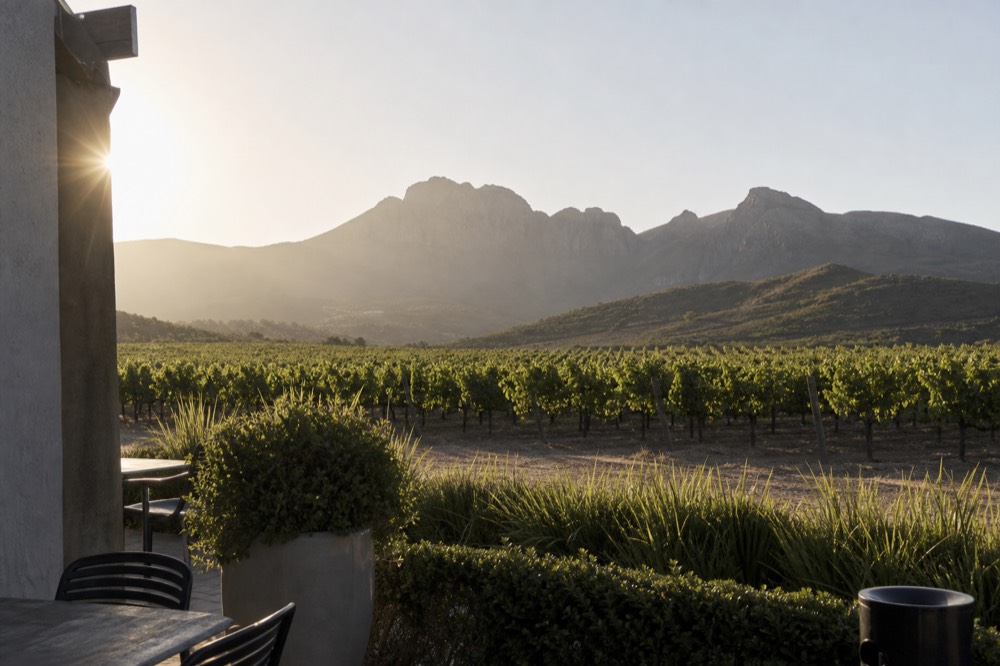
Season and day of week matter more than in most wine regions. Weekends from December to February are the crush of both local and international visitors; Wesgro's visitor tracking for the Cape Winelands in the first half of 2025 found the visitor base is overwhelmingly domestic, heavily from the Western Cape, which is why Saturdays in season feel local-busy, not just tourist-busy. Midweek days in shoulder season are a different experience entirely, with shorter queues and more time with the cellar door staff.
Weather is rarely a dealbreaker. The region has a Mediterranean climate, hot dry summers and cool wet winters, and the "Cape Doctor" south-easterly wind blows from September to March, which can make exposed terraces blustery but keeps tasting days pleasant. Winter visits are quieter and greener, with indoor cellar tastings the norm.
If your dates are flexible and food is the priority, watch the events calendar. Franschhoek's calendar runs deep through the year: La Motte's Harvest Experience ran Mondays to Saturdays from late January through mid-March 2026 at R300 per person, the JAN Franschhoek Michelin-starred pop-up returned to La Motte for a fifth season running September 2026 to April 2027, and harvest-season events like grape stomping at Babylonstoren's Soetmelksvlei ran in February 2026 at R550 per person. A private day can be built around an event like that; a group itinerary cannot.
One more planning note for mixed groups: Constantia, inside Cape Town's southern suburbs just 20 to 25 minutes from the City Bowl via the M3, makes a practical half-day alternative or add-on for travelers who cannot spare a full winelands day. Klein Constantia in that valley ranked #6 in the World's 50 Best Vineyards 2025, named Best Vineyard in Africa, so the wine standard is not a step down. A private format can pair Cape Point and Constantia in one day, which is exactly what the option below does.
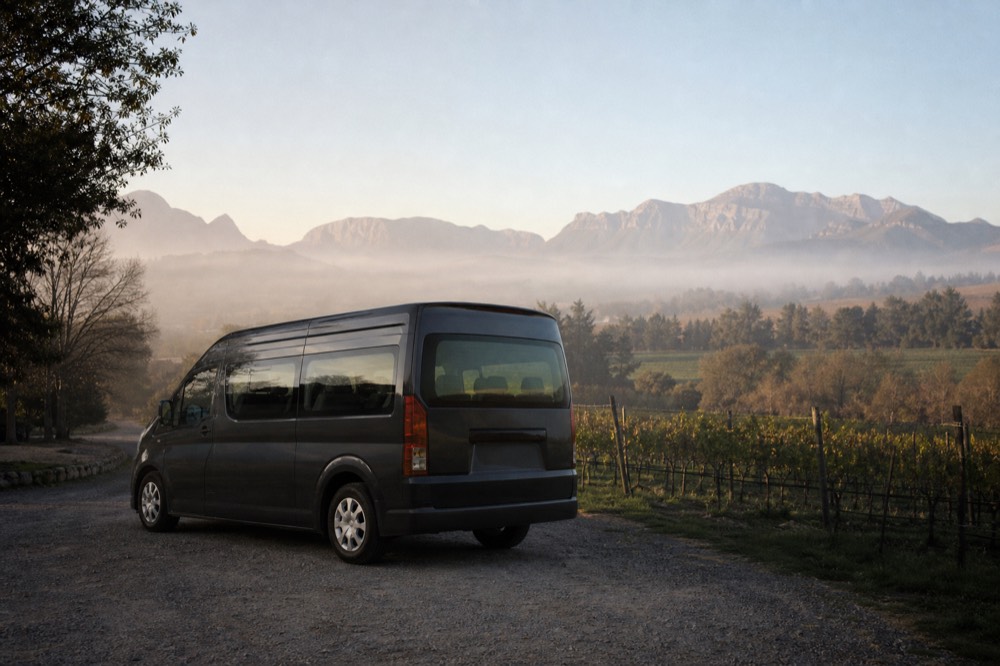
For the full luxury treatment of the same valley, the related option below is the site's flagship private Winelands day, and it is the natural upgrade if the comparison in this guide has landed you firmly in the private-driver camp. Whichever format you choose, the decision framework on Cape Town Wine Tours is the same: match the format to your group size, your estate wishlist and how much of the day you want to own.
The short answers: a private tour beats the tram on flexibility and reach, the tram beats it on price at R350 per adult, the drive is 60 to 70 minutes each way, tasting fees of R80 to R250 per estate are usually paid at the cellar door, three estates plus lunch is the comfortable daily maximum, and harvest season from late January through April is the most energetic time to go.
Common questions about Franschhoek private wine tours
Is a private Franschhoek wine tour worth it over the Wine Tram?
A private tour is worth it if you value flexibility, want off-tram-network or appointment-only estates, are a group of four or more where per-vehicle pricing evens out, or want to combine Franschhoek with Stellenbosch or Paarl in one day. The tram, at R350 per adult, wins on price and charm for confident independent planners happy to stay on its lines.
How far is Franschhoek from Cape Town?
Franschhoek is roughly 75 km from central Cape Town, a 60 to 70 minute drive, about 30 minutes further inland from Stellenbosch via scenic passes like Helshoogte. A full-day tour including transfers typically runs 9 to 10 hours door to door.
Are tasting fees included in a private wine tour?
Usually not. Tasting fees typically run R80 to R250 per person per estate and are paid at the cellar door, though many estates waive or refund the fee with a bottle purchase. Check the inclusions on the operator's live listing before booking, since some tours do bundle selected tastings.
Can we drink on a wine tour if nobody is driving?
Yes, that is the point of booking a driver. South Africa's drinking age is 18 nationwide, tasting rooms must check ID for anyone who appears under 18, and your professional tour driver is held to a stricter 0.02 blood-alcohol limit than the 0.05 limit for ordinary drivers, so the person behind the wheel is effectively required to be sober.
How many wineries can you visit in one Franschhoek day?
Three estates plus a leisurely lunch is the comfortable maximum for a day with 60 to 70 minute transfers each way. Itineraries promising four or five estates typically run short 30 to 45 minute stops. A private format lets you set that pace yourself.
When is the best time of year for a Franschhoek wine tour?
Harvest season runs late January through April and brings festive energy and hands-on events, but December to February is also peak crowding. The shoulder months of September to November and post-harvest March to April balance crowds, weather and availability, and winter visits are quiet and green with indoor tastings.